The navigation property in docs.json controls the structure and information hierarchy of your documentation. With proper navigation configuration, you can organize your content so that users can find exactly what they’re looking for. Choose one primary organizational pattern at the root level of your navigation. Once you’ve chosen your primary pattern, you can nest other navigation elements within it.

Pages

Pages are the most fundamental navigation component. Each page is an MDX file in your documentation repository. Decorative graphic of pages. In the navigation object, pages is an array where each entry must reference the path to a page file.


{
  "navigation": {
    "pages": [
      "settings",
      "pages",
      "navigation",
      "themes",
      "custom-domain"
    ]
  }
}

Groups

Use groups to organize your sidebar navigation into sections. You can nest groups within each other, label them with tags, and style them with icons. Decorative graphic of groups. In the navigation object, groups is an array where each entry is an object that requires a group field and a pages field. The icon, tag, root, and expanded fields are optional.


{
  "navigation": {
    "groups": [
      {
        "group": "Getting started",
        "icon": "play",
        "pages": [
          "quickstart",
          {
            "group": "Editing",
            "expanded": false,
            "icon": "pencil",
            "pages": [
              "installation",
              "editor"
            ]
          }
        ]
      },
      {
        "group": "Writing content",
        "icon": "notebook-text",
        "tag": "NEW",
        "pages": [
          "writing-content/page",
          "writing-content/text"
        ]
      }
    ]
  }
}

Root page

Use the root property to designate a main page for a group. When a group has a root page, clicking the group title in the sidebar navigation opens the root page. Root pages work for top-level and nested groups.
Example group with a root page
{
  "navigation": {
    "groups": [
      {
        "group": "API pages",
        "root": "api-overview",
        "pages": [
          "api-reference/get",
          "api-reference/post",
          "api-reference/delete"
        ]
      }
    ]
  }
}

Default expanded state

Use the expanded property to control the default state of a nested group in the navigation sidebar.
  • expanded: true: Group is expanded by default.
  • expanded: false or omitted: Group is collapsed by default.
The expanded property only affects nested groups—groups within groups. Top-level groups are always expanded and cannot be collapsed.
{
  "group": "Getting started",
  "pages": [
    "quickstart",
    {
      "group": "Advanced",
      "expanded": false,
      "pages": ["installation", "configuration"]
    }
  ]
}

Tabs

Tabs create distinct sections of your documentation with separate URL paths. Tabs create a horizontal navigation bar at the top of your documentation that lets users switch between sections. Decorative graphic of a tab navigation. In the navigation object, tabs is an array where each entry is an object that requires a tab field and can contain other navigation fields such as groups, pages, icons, or links to external pages.


{
  "navigation": {
    "tabs": [
      {
        "tab": "API reference",
        "icon": "square-terminal",
        "pages": [
          "api-reference/get",
          "api-reference/post",
          "api-reference/delete"
        ]
      },
      {
        "tab": "SDKs",
        "icon": "code",
        "pages": [
          "sdk/fetch",
          "sdk/create",
          "sdk/delete"
        ]
      },
      {
        "tab": "Blog",
        "icon": "newspaper",
        "href": "https://external-link.com/blog"
      }
    ]
  }
}
Menus add dropdown navigation items to a tab. Use menus to help users go directly to specific pages within a tab. In the navigation object, menu is an array where each entry is an object that requires an item field and can contain other navigation fields such as groups, pages, icons, or links to external pages. Menu items can only contain groups, pages, and external links.
{
  "navigation": {
    "tabs": [
      {
        "tab": "Developer tools",
        "icon": "square-terminal",
        "menu": [
          {
            "item": "API reference",
            "icon": "rocket",
            "groups": [
              {
                "group": "Core endpoints",
                "icon": "square-terminal",
                "pages": [
                  "api-reference/get",
                  "api-reference/post",
                  "api-reference/delete"
                ]
              }
            ]
          },
          {
            "item": "SDKs",
            "icon": "code",
            "description": "SDKs are used to interact with the API.",
            "pages": [
              "sdk/fetch",
              "sdk/create",
              "sdk/delete"
            ]
          }
        ]
      }
    ]
  }
}

Anchors

Anchors add persistent navigation items to the top of your sidebar. Use anchors to section your content, provide quick access to external resources, or create prominent calls to action. Decorative graphic of an anchor navigation. In the navigation object, anchors is an array where each entry is an object that requires an anchor field and can contain other navigation fields such as groups, pages, icons, or links to external pages.


{
  "navigation": {
    "anchors": [
      {
        "anchor": "Documentation",
        "icon": "book-open",
        "pages": [
          "quickstart",
          "development",
          "navigation"
        ]
      },
      {
        "anchor": "API reference",
        "icon": "square-terminal",
        "pages": [
          "api-reference/get",
          "api-reference/post",
          "api-reference/delete"
        ]
      },
      {
        "anchor": "Blog",
        "href": "https://external-link.com/blog"
      }
    ]
  }
}

Global anchors

Use global anchors for links that should appear on all pages, regardless of which section of your navigation the user is viewing. Global anchors are particularly useful for linking to resources outside your documentation (such as a blog, community forum, or support portal) or for providing consistent access to important internal pages (such as a changelog or status page). Global anchors support both external URLs and relative paths to pages within your documentation.
{
  "navigation": {
    "global":  {
      "anchors": [
        {
          "anchor": "Changelog",
          "icon": "list",
          "href": "/changelog"
        },
        {
          "anchor": "Blog",
          "icon": "pencil",
          "href": "https://mintlify.com/blog"
        }
      ]
    },
    "tabs": /*...*/
  }
}
Dropdowns are an expandable menu at the top of your sidebar navigation. Each item in a dropdown directs to a section of your documentation. Decorative graphic of a dropdown navigation. In the navigation object, dropdowns is an array where each entry is an object that requires a dropdown field and can contain other navigation fields such as groups, pages, icons, or links to external pages.


{
  "navigation": {
    "dropdowns": [
      {
        "dropdown": "Documentation",
        "icon": "book-open",
        "pages": [
          "quickstart",
          "development",
          "navigation"
        ]
      },
      {
        "dropdown": "API reference",
        "icon": "square-terminal",
        "pages": [
          "api-reference/get",
          "api-reference/post",
          "api-reference/delete"
        ]
      },
      {
        "dropdown": "Blog",
        "href": "https://external-link.com/blog"
      }
    ]
  }
}

Products

Decorative graphic of a product switcher. Products create a dedicated navigation division for organizing product-specific documentation. Use products to separate different offerings, services, or major feature sets within your documentation. In the navigation object, products is an array where each entry is an object that requires a product field and can contain other navigation fields such as groups, pages, icons, or links to external pages.
{
  "navigation": {
    "products": [
      {
        "product": "Core API",
        "description": "Core API description",    
        "icon": "api",
        "groups": [
          {
            "group": "Getting started",
            "pages": [
              "core-api/quickstart",
              "core-api/authentication"
            ]
          },
          {
            "group": "Endpoints",
            "pages": [
              "core-api/users",
              "core-api/orders"
            ]
          }
        ]
      },
      {
        "product": "Analytics Platform",
        "description": "Analytics Platform description",
        "icon": "chart-bar",
        "pages": [
          "analytics/overview",
          "analytics/dashboard",
          "analytics/reports"
        ]
      },
      {
        "product": "Mobile SDK",
        "description": "Mobile SDK description",
        "icon": "smartphone",
        "href": "https://mobile-sdk-docs.example.com"
      }
    ]
  }
}

OpenAPI

Integrate OpenAPI specifications directly into your navigation structure to automatically generate API documentation. Create dedicated API sections or place endpoint pages within other navigation components. Set a default OpenAPI specification at any level of your navigation hierarchy. Child elements inherit the specification unless they define their own.
When you add the openapi property to a navigation element (such as an anchor, tab, or group) without specifying any pages, Mintlify automatically generates pages for all endpoints defined in your OpenAPI specification.To control which endpoints appear, explicitly list the desired endpoints in a pages array.
For more information about referencing OpenAPI endpoints in your docs, see the OpenAPI setup.
{
  "navigation": {
    "groups": [
      {
        "group": "API reference",
        "openapi": "/path/to/openapi-v1.json",
        "pages": [
          "overview",
          "authentication",
          "GET /users",
          "POST /users",
          {
            "group": "Products",
            "openapi": "/path/to/openapi-v2.json",
            "pages": [
              "GET /products",
              "POST /products"
            ]
          }
        ]
      }
    ]
  }
}

Versions

Partition your navigation into different versions. Versions are selectable from a dropdown menu. Decorative graphic of a version switcher. In the navigation object, versions is an array where each entry is an object that requires a version field and can contain any other navigation fields.


{
  "navigation": {
    "versions": [
      {
        "version": "1.0.0",
        "groups": [
          {
            "group": "Getting started",
            "pages": ["v1/overview", "v1/quickstart", "v1/development"]
          }
        ]
      },
      {
        "version": "2.0.0",
        "groups": [
          {
            "group": "Getting started",
            "pages": ["v2/overview", "v2/quickstart", "v2/development"]
          }
        ]
      }
    ]
  }
}

Languages

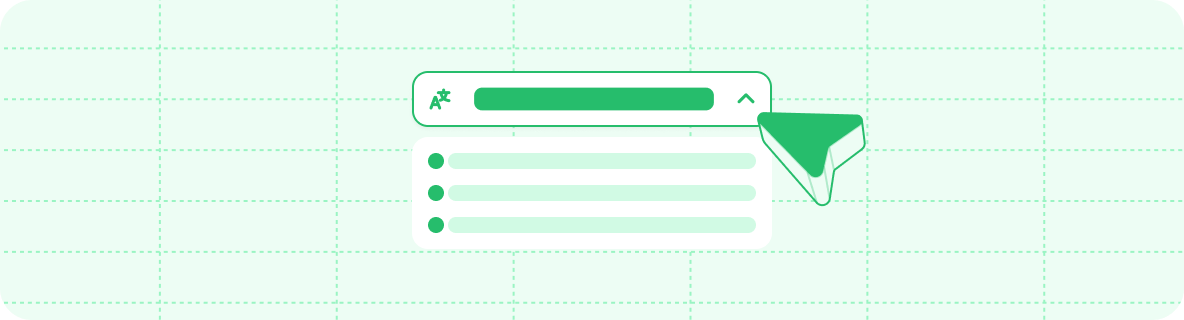
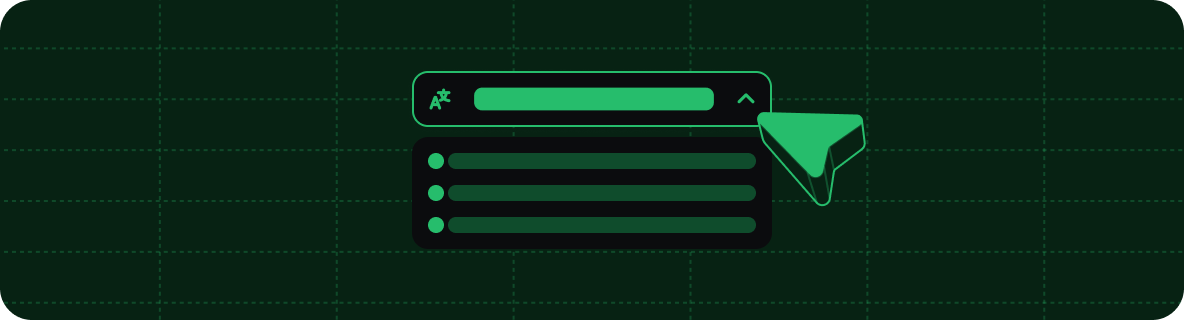
Partition your navigation into different languages. Languages are selectable from a dropdown menu. Decorative graphic of a language switcher. In the navigation object, languages is an array where each entry is an object that requires a language field and can contain any other navigation fields, including language-specific banner configurations. We currently support the following languages for localization:
https://mintcdn.com/mintlify-vale-style-fixes-1771636814/OZMTeDhoH3eNtQx0/images/navigation/languages/ar.png?fit=max&auto=format&n=OZMTeDhoH3eNtQx0&q=85&s=85c85ba02352686ac295836b83401988

Arabic (ar)

https://mintcdn.com/mintlify-vale-style-fixes-1771636814/JlLIkwB15BJ8jhO5/images/navigation/languages/cs.png?fit=max&auto=format&n=JlLIkwB15BJ8jhO5&q=85&s=83807a76e300e2f2829191c9f0b35877

Czech (cs)

https://mintcdn.com/mintlify-vale-style-fixes-1771636814/JlLIkwB15BJ8jhO5/images/navigation/languages/cn.png?fit=max&auto=format&n=JlLIkwB15BJ8jhO5&q=85&s=43a0d7c658ebee9e9f19f6fb35d368d0

Chinese (cn)

https://mintcdn.com/mintlify-vale-style-fixes-1771636814/JlLIkwB15BJ8jhO5/images/navigation/languages/cn.png?fit=max&auto=format&n=JlLIkwB15BJ8jhO5&q=85&s=43a0d7c658ebee9e9f19f6fb35d368d0

Chinese (zh-Hant)

https://mintcdn.com/mintlify-vale-style-fixes-1771636814/JlLIkwB15BJ8jhO5/images/navigation/languages/nl.png?fit=max&auto=format&n=JlLIkwB15BJ8jhO5&q=85&s=cdbf3ea9f5c59c765ee3dfdf456856b3

Dutch (nl)

https://mintcdn.com/mintlify-vale-style-fixes-1771636814/JlLIkwB15BJ8jhO5/images/navigation/languages/en.png?fit=max&auto=format&n=JlLIkwB15BJ8jhO5&q=85&s=0eb2be4d9b16be2e14ebcf7e3f0c1d60

English (en)

https://mintcdn.com/mintlify-vale-style-fixes-1771636814/JlLIkwB15BJ8jhO5/images/navigation/languages/fr.png?fit=max&auto=format&n=JlLIkwB15BJ8jhO5&q=85&s=5c196278dfdc20bd7ab830c96baea501

French (fr)

https://mintcdn.com/mintlify-vale-style-fixes-1771636814/JlLIkwB15BJ8jhO5/images/navigation/languages/de.png?fit=max&auto=format&n=JlLIkwB15BJ8jhO5&q=85&s=c956c953286c406e881fa4fd03202131

German (de)

https://mintcdn.com/mintlify-vale-style-fixes-1771636814/JlLIkwB15BJ8jhO5/images/navigation/languages/he.png?fit=max&auto=format&n=JlLIkwB15BJ8jhO5&q=85&s=2a90735fb229b6eee9cb1dcc16ea4b56

Hebrew (he)

https://mintcdn.com/mintlify-vale-style-fixes-1771636814/JlLIkwB15BJ8jhO5/images/navigation/languages/hi.png?fit=max&auto=format&n=JlLIkwB15BJ8jhO5&q=85&s=e57194deeec960cae1d3dc15a9e3ac64

Hindi (hi)

https://mintcdn.com/mintlify-vale-style-fixes-1771636814/JlLIkwB15BJ8jhO5/images/navigation/languages/id.png?fit=max&auto=format&n=JlLIkwB15BJ8jhO5&q=85&s=f02d0fb9d6a2a7f5161b847ab8738007

Indonesian (id)

https://mintcdn.com/mintlify-vale-style-fixes-1771636814/JlLIkwB15BJ8jhO5/images/navigation/languages/it.png?fit=max&auto=format&n=JlLIkwB15BJ8jhO5&q=85&s=d63a0c849223b1fdbb062529ae32df3c

Italian (it)

https://mintcdn.com/mintlify-vale-style-fixes-1771636814/JlLIkwB15BJ8jhO5/images/navigation/languages/jp.png?fit=max&auto=format&n=JlLIkwB15BJ8jhO5&q=85&s=388364c0a2c31b1284be79e02595125b

Japanese (jp)

https://mintcdn.com/mintlify-vale-style-fixes-1771636814/JlLIkwB15BJ8jhO5/images/navigation/languages/ko.png?fit=max&auto=format&n=JlLIkwB15BJ8jhO5&q=85&s=9387adddc2b8945a35d547aaf5767372

Korean (ko)

https://mintcdn.com/mintlify-vale-style-fixes-1771636814/JlLIkwB15BJ8jhO5/images/navigation/languages/lv.png?fit=max&auto=format&n=JlLIkwB15BJ8jhO5&q=85&s=e792a315cc760c9ceaad708f9777576c

Latvian (lv)

https://mintcdn.com/mintlify-vale-style-fixes-1771636814/JlLIkwB15BJ8jhO5/images/navigation/languages/no.png?fit=max&auto=format&n=JlLIkwB15BJ8jhO5&q=85&s=571da06f208c8e501f5955a789c31c9a

Norwegian (no)

https://mintcdn.com/mintlify-vale-style-fixes-1771636814/JlLIkwB15BJ8jhO5/images/navigation/languages/pl.png?fit=max&auto=format&n=JlLIkwB15BJ8jhO5&q=85&s=226deec90b730567e79b3673dec60444

Polish (pl)

https://mintcdn.com/mintlify-vale-style-fixes-1771636814/JlLIkwB15BJ8jhO5/images/navigation/languages/pt-br.png?fit=max&auto=format&n=JlLIkwB15BJ8jhO5&q=85&s=84d45a226f911f38b3dfccf577f9a8a6

Portuguese (pt-BR)

https://mintcdn.com/mintlify-vale-style-fixes-1771636814/JlLIkwB15BJ8jhO5/images/navigation/languages/ro.png?fit=max&auto=format&n=JlLIkwB15BJ8jhO5&q=85&s=0d11c27e9a0b9a869557009a973e086f

Romanian (ro)

https://mintcdn.com/mintlify-vale-style-fixes-1771636814/JlLIkwB15BJ8jhO5/images/navigation/languages/ru.png?fit=max&auto=format&n=JlLIkwB15BJ8jhO5&q=85&s=e7a918cde4497e7b3a9da2e85b2f44d6

Russian (ru)

https://mintcdn.com/mintlify-vale-style-fixes-1771636814/JlLIkwB15BJ8jhO5/images/navigation/languages/es.png?fit=max&auto=format&n=JlLIkwB15BJ8jhO5&q=85&s=4cb212e630b9a82b857093c91caec7cb

Spanish (es)

https://mintcdn.com/mintlify-vale-style-fixes-1771636814/JlLIkwB15BJ8jhO5/images/navigation/languages/sv.png?fit=max&auto=format&n=JlLIkwB15BJ8jhO5&q=85&s=1a0ca3ce1787d4a12fc9c0b7c1b98bc4

Swedish (sv)

https://mintcdn.com/mintlify-vale-style-fixes-1771636814/JlLIkwB15BJ8jhO5/images/navigation/languages/tr.png?fit=max&auto=format&n=JlLIkwB15BJ8jhO5&q=85&s=e14850427d240e8aba9368afced4ab71

Turkish (tr)

https://mintcdn.com/mintlify-vale-style-fixes-1771636814/JlLIkwB15BJ8jhO5/images/navigation/languages/ua.png?fit=max&auto=format&n=JlLIkwB15BJ8jhO5&q=85&s=d5fe19684783faf7024411ee974dec5b

Ukrainian (ua)

https://mintcdn.com/mintlify-vale-style-fixes-1771636814/JlLIkwB15BJ8jhO5/images/navigation/languages/uz.png?fit=max&auto=format&n=JlLIkwB15BJ8jhO5&q=85&s=3878b563d0637f5d074b0878cb3112aa

Uzbek (uz)

https://mintcdn.com/mintlify-vale-style-fixes-1771636814/JlLIkwB15BJ8jhO5/images/navigation/languages/vi.png?fit=max&auto=format&n=JlLIkwB15BJ8jhO5&q=85&s=c9f63ce164f0d1a64de8adef1f093b9b

Vietnamese (vi)

{
  "navigation": {
    "languages": [
      {
        "language": "en",
        "banner": {
          "content": "🚀 Version 2.0 is now live! See our [changelog](/en/changelog) for details.",
          "dismissible": true
        },
        "groups": [
          {
            "group": "Getting started",
            "pages": ["en/overview", "en/quickstart", "en/development"]
          }
        ]
      },
      {
        "language": "es",
        "banner": {
          "content": "🚀 ¡La versión 2.0 ya está disponible! Consulta nuestro [registro de cambios](/es/changelog).",
          "dismissible": true
        },
        "groups": [
          {
            "group": "Getting started",
            "pages": ["es/overview", "es/quickstart", "es/development"]
          }
        ]
      }
    ]
  }
}
For automated translations, contact our sales team to discuss solutions.

Nesting

Navigation elements can be nested within each other to create complex hierarchies. You must have one root-level parent navigation element such as tabs, groups, or a dropdown. You can nest other types of navigation elements within your primary navigation pattern. Each navigation element can contain one type of child element at each level of your navigation hierarchy. For example, a tab can contain anchors that contain groups, but a tab cannot contain both anchors and groups at the same level.
{
  "navigation": {
    "tabs": [
      {
        "tab": "Documentation",
        "anchors": [
          {
            "anchor": "Guides",
            "icon": "book-open",
            "pages": ["quickstart", "tutorial"]
          },
          {
            "anchor": "API Reference",
            "icon": "code",
            "pages": ["api/overview", "api/endpoints"]
          }
        ]
      },
      {
        "tab": "Resources",
        "groups": [
          {
            "group": "Help",
            "pages": ["support", "faq"]
          }
        ]
      }
    ]
  }
}
Breadcrumbs display the full navigation path at the top of pages. Some themes have breadcrumbs enabled by default and others do not. You can control whether breadcrumbs display on your site using the styling property in your docs.json.
"styling": {
  "eyebrows": "breadcrumbs"
}

Interaction configuration

Control how users interact with navigation elements using the interaction property in your docs.json.

Enable auto-navigation for groups

When a user expands a navigation group, some themes automatically navigate to the first page in the group. You can override a theme’s default behavior using the drilldown option.
  • Set to true to force automatic navigation to the first page when a user selects a navigation group.
  • Set to false to prevent navigation and only expand or collapse the group when a user selects a navigation group.
  • Leave unset to use the theme’s default behavior.
"interaction": {
  "drilldown": true  // Force navigation to first page when a user expands a dropdown
}